A Common Ground Beneath Our Feet
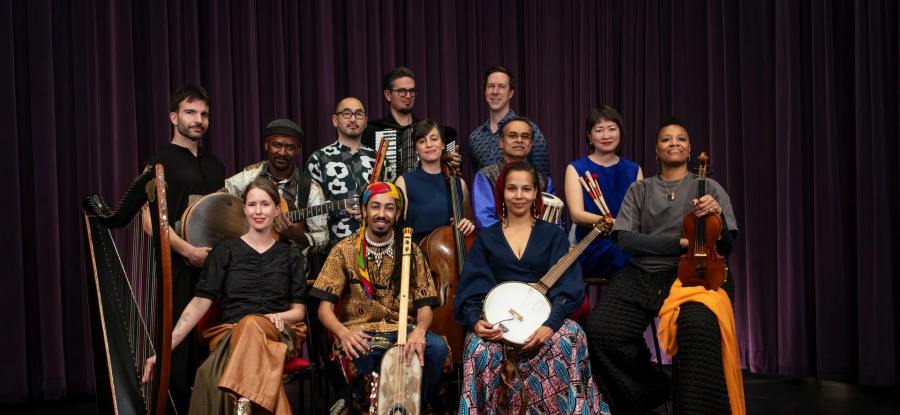
There are musical projects that are built around a repertoire, others around a geography, and others still around a specific aesthetic vision. The Silkroad Ensemble belongs to a different category: it is a living organism built around an idea. A simple and radical idea at once—that music can be a real space of encounter between cultures, not as a symbolic gesture, but as a daily, concrete, lived practice. Founded in 1998 by Yo-Yo Ma, Silkroad has never been an ensemble in the traditional sense. There is no fixed lineup, no stable repertoire. Instead, it is a community of musicians from different traditions, chosen not only for their technical excellence, but for their ability to inhabit a threshold—the space between rootedness and transformation. Each musician brings with them a language, a sound, a memory. What matters most is the willingness to place that language in dialogue with others, without hierarchy.
Entering this context means immediately finding yourself in a space where musical identity is not something to defend, but something to offer. The pizzica, the frame drums, the violin I carry with me are no longer only instruments of a local tradition, but elements in a broader conversation, where every sound is heard both for what it is and for what it might become. It is within this space that my participation in Sanctuary: The Power of Resonance and Ritual began to take shape. Even before the music itself, what stands out is the quality of listening. A real, deep listening, in which every musical gesture is at once personal and collective. This, perhaps, is the true nature of Silkroad: not simply an ensemble, but a place. A circle. A space where music returns to what it has always been—a form of relationship.
Sanctuary: The Power of Resonance and Ritual Music as Refuge and Resistance The word sanctuary can be understood in many ways: refuge, protected space, a place where it is still possible to pause, to listen, to rebuild a sense of community. Working on this project in the United States today carries a particular weight. This is a country marked by deep and increasingly visible tensions, where public discourse is often shaped by fear, by closure, by the idea that identity is something to be defended against someone else. The same tendency can be seen elsewhere—in Italy, across Europe, and in many parts of the world. The rise of nationalism, ongoing wars, and increasingly restrictive migration policies contribute to a climate in which separation begins to feel like the natural order of things. Within this context, finding yourself in a room each day with musicians from Morocco, India, Japan, Armenia, Scotland, Congo, Italy, and the United States becomes something very real. Each person brings their own history, their own sound, their own way of inhabiting music. What emerges is not a fusion of identities, but their coexistence. The taranta, Gnawa music, Indian classical tradition, American folk music—these practices were never conceived merely as forms of entertainment. They were born as tools to accompany moments of transformation, to help individuals and communities move through crisis, grief, healing, and renewal. Sanctuary begins with this understanding. With the idea that music can still be a space where encounter is possible without the need to simplify or protect oneself. A space where listening becomes an act of trust. Something simple and real happens: people from different parts of the world breathe together, listen together, and build something that did not exist before. In a time that often pushes toward division, this act acquires a different weight. It becomes, in its own quiet way, a form of resistance.
Entering the Circle The first rehearsals are always a delicate moment. I took part in an initial workshop in Ireland last December, with a smaller group—Rhiannon, Mazz, Francesco, Niwel, and myself—and then a second workshop with the full ensemble in January, followed by a beautiful preview performance in New York on January 10, 2026, as part of the Winter Jazz Fest. At that stage, there is no shared language yet. You observe each other, you play, you try things, you listen. What strikes you immediately is the extraordinary musical and human level of the people involved. They are incredible. Not only great instrumentalists, but musicians who have developed a deep relationship with their own musical traditions, and who have learned to question them, to keep them flexible and alive. The Hawaiian bassist Shawn Conley, for example, moves effortlessly between bow and pizzicato, shifting from a lyrical, singing tone to remarkable rhythmic agility, using the instrument with a freedom that easily recalls the expressive range of a cello. Beside him, Scottish harpist Maeve Gilchrist brings a presence that is both refined and fearless. Beyond a complete mastery of everything one might expect from the harp—the luminous, almost celestial sound—she possesses an extraordinary rhythmic and harmonic awareness, and a musical curiosity that allows her to make bold, unexpected choices without hesitation. Armenian cellist Karen Ouzounian represents the very highest level of classical tradition, but with something more: a strong personal voice, a deep compositional sensibility, and a lyrical approach to improvisation that makes every gesture feel necessary. With Francesco Turrisi, who like me comes from Italy, we already share a longer history. Yet I remain constantly struck by his ability to move between radically different instruments—accordion, piano, frame drums, string instruments—with complete naturalness. His immense musicality is not tied to any single instrument, but to a broader understanding of sound, form, and structure. Congolese guitarist Niwel Tsumbu is simply one of the finest guitarists I have ever encountered. His relationship with the guitar transcends the instrument itself. He brings together a deep knowledge of African musical traditions, an innate rhythmic sensibility, refined harmonic awareness, and an extraordinary improvisational freedom. Kaoru Watanabe embodies, in a profound way, the idea that tradition is also a choice. Japanese and American, he moves fluidly between cultural languages with a rare balance of respect, discipline, and expressive freedom. His playing is never a reproduction of the past, but its living continuation.
Sandeep Das’s presence on tabla is a constant point of reference. He is, quite literally, a guru of Indian music, and yet his authority never creates distance. On the contrary, he makes every interaction feel natural, effortless, both musically and humanly. Japanese percussionist Haruka Fujii brings an extraordinary level of precision and listening. Her virtuosity is never displayed for its own sake, but always placed in service of the music, strengthening the cohesion of the ensemble. American violinist and vocalist Mazz Swift embodies a rare combination of strength and openness. Their voice and violin move fluidly across genres and traditions, grounded yet constantly searching, expanding the expressive space of the group. And then there is Rhiannon. It is difficult to find a single word that captures her presence. She is a complete musician—singer, instrumentalist, composer, dancer, and leader—but above all, she possesses a clarity of vision that holds everything together and inspires everyone around her. Her leadership does not operate through control, but through listening. She creates a space in which each musician can fully express themselves, while contributing to something larger than any individual voice.
Common Ground "Common Ground" is the pizzica I wrote for the Silkroad Ensemble. I use the word “wrote” with caution, because the piece truly exists only through the creative contribution of each musician involved. I laid the foundations: the rhythm, the groove, the structure, the overall architecture, and the fixed melodic and harmonic elements. But what makes it alive is the way each musician inhabits it. The idea first emerged during the workshop in Ireland. At that stage, we were still searching for common ground, a way of being together musically without renouncing our individual identities. It felt natural for me to bring the rhythm of pizzica—my familiar and chosen refuge, my Sanctuary. Back home, I began to develop that intuition, shaping a structure that preserved the physical and rhythmic core of the tradition, while remaining open enough to allow each musician to find their own place within it. We worked on the piece during the workshop in the United States, and performed it live for the first time in New York, just days later, at the Winter Jazz Fest. It was extraordinary to witness how naturally each musician entered that rhythm without hesitation. No one was trying to imitate something that did not belong to them. Instead, each voice emerged clearly, freely coexisting alongside the others. In that moment, I understood that the piece had found its true meaning. It was no longer simply the pizzica I had written, but a shared space. A Common Ground laid beneath our feet. Experiences like this change you in subtle but lasting ways. The energy they transmit, the enthusiasm, the renewed sense of trust in the future—all of it remains.
A few years ago, I was in Adelaide to perform at WOMAD with Justin Adams, and the night before our concert I had the chance to attend a performance by Billy Bragg. At one point, he said something that has stayed with me ever since: “Music does not have the power to change the world. But it can make you believe that the world can be changed.”
Further information about the Silk Road project
Search RootsWorld
|
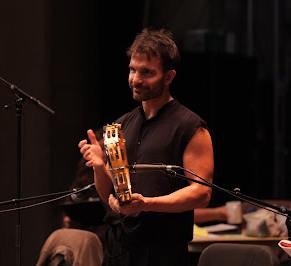 In 2026, I was invited to join the Silkroad Ensemble, the international collective directed by Rhiannon Giddens, as a musician (frame drums, violin, and voice) and contributor of new arrangements and compositions. Following an initial workshop and preview performance in New York in January 2026, the project will unfold through a North American tour in March 2026, featuring nine concerts alongside workshops and community outreach activities across the United States, as part of the new program Sanctuary: The Power of Resonance and Ritual. The tour will continue later in the year with further residencies and performances in North America and Europe.
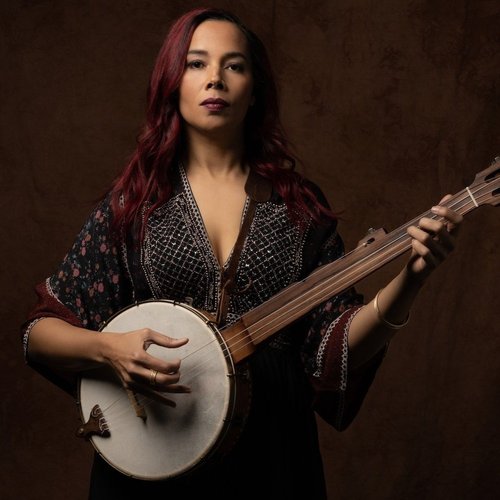 In recent years, the project has been guided by Rhiannon Giddens, one of the most powerful and deeply insightful voices in contemporary music. Her presence gives the work a clear direction: the goal is not to create an artificial synthesis of traditions, but to create the conditions for each tradition to speak fully, and to transform through encounter. Rhiannon possesses a rare kind of leadership—one that never imposes itself, but quietly shapes the space, both musically and humanly.
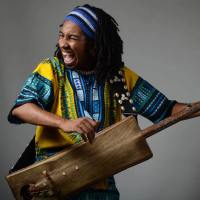 With Mehdi Nassouli, on guembri and voice, I feel a particular closeness. Like me with pizzica, he belongs deeply to a specific musical world—in his case, the Gnawa tradition of Morocco. Yet his experience has given him an equally deep ability to engage in dialogue with other musical languages, without ever losing the center of his own sound.