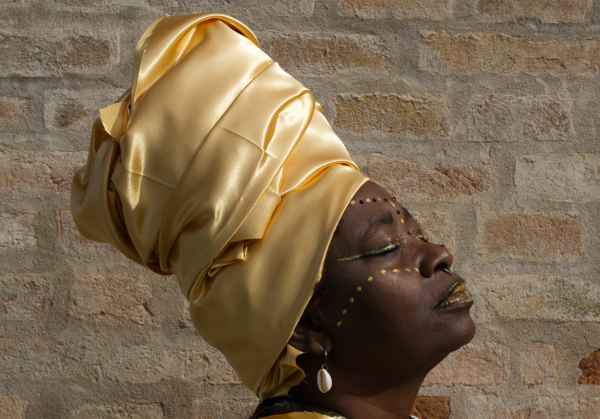
Nilza Costa
A resident of Italy since 2006, Nilza was born in Brazil and maintains a rich connection to her African roots. Honing her one-of-a-kind contralto voice as a church choir soloist in her hometown of Salvador, Bahia, on the Atlantic coast, she burst onto the world music stage with her mature, polished debut Revolution, Rivoluzione, Revolução (2014). On her fourth full-length release, Nilza continues to develop her distinctive sound. Salsa blends with modern jazz and tribal chants into a mesmerizing array of sounds that mesh pleasingly into a cohesive whole. It is a quilt of many seemingly jarring fabrics that, together, create an aural warmth, sewn together by Nilza’s coffee-and-cigar tinged singing and outstanding collaborating musicians. Niza is known for her electrifying live shows, and Cantigas is structured like a festival set, opening with an instrumental as the crack band warms up the audience for the star waiting in the wings. Traditional and modern simultaneously, “Ramunha” fills your headphones with a wall-of-sound, polyrhythmic percussion intro, warmly recorded and deftly placed around the stereo mix. Then a jazz combo enters with furious drumming by Roberto Rossi and Maurizio Piancastelli’s Miles Davis-influenced trumpet solo, warm and richly voiced.
With “Exu”, the star takes the stage with spoken word, chants, and multi-tracked backing vocals over an afro-beat undercoat. The songs are intensely spiritual meditations derived from the Yoruba religion and are often sung in that language. According to the liner notes, “Each song is an intense expression of faith, capable of evoking the elements of nature and humanity, telling stories of struggle, resilience, and the dignity of Black People throughout the diaspora.” Nilza’s authoritative voice is perfectly suited to the depth of the stories that she tells. The songs also display a remarkable range of patterns, structures, and moods. On “Ogum Suite,” we hear a series of episodes beginning with an atmospheric chant over guitar, electric piano, and flute. Then the music leaps from afro-beat to modern jazz combo, finishing with a melodic coda and another soaring trumpet solo.
Hearing the hymn-like and celebratory “Orki A Obaluaye” created a genuine wow moment. It begins with chiming electric guitars in the left and right channels and a frank recitation before launching into a beautiful tune further enriched by Piancastelli’s trumpet and guest Léo Gandelman on tenor sax. The ever-helpful notes explain that this song describes “the union of masculine and feminine, life and death, and the continuity of all things”. Visual artists are notable for how they show what they are uniquely able to see; musical artists impress by reconstituting the music they have absorbed. Along with her big voice, Nilza uses her big ears to synthesize a vast range of influences. Yet there is a consistent voice across her recordings, with each providing a new taster’s menu with new flavours and textures. On this recording, there is also a restless energy as if she is impatient to get all of the music she has inside out to us. The instrumental “Final Ramunha” ends the set with the front of the stage empty and fades away as if leaving the audience wanting more and likely shouting for an encore. Have a listen for yourself and look out for a show near you.
Search RootsWorld
|