Antoine Dougbé
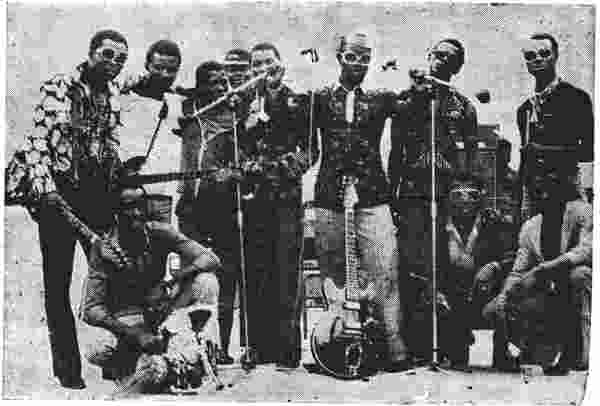
Antoine Dougbé et L'Orchestre Poly-Rythmo De Cotonou 1977 - 1982
Analog Africa
Review by Bruce Miller


Those of us who have been digging into Analog Africa’s increasingly formidable releases over the last two decades are well aware of the massive amount of raw, vodun-based Sato and Sakpata-derived funk the label has issued by Benin’s most prolific 1970s-era band, the Orchestre Poly-Ritmo. AA has dropped no fewer than 3 compilations of their heaviest material, as well as a reissue of the band’s first LP, in an effort to give them the international status they deserve. That being said, what might be different about this collection of their music? And who is Antoine Dougbé?
As it turns out, Dougbé was a song-conjurer whose mode of musical transfer was slapping his legs in a rhythm known as Cavacha, a groove created by drummer Belobi Meridjo, who was inspired by a train cadence that he worked into a pattern that ultimately spread like a 21st century California wildfire throughout Congolese pop music in the mid-1970s. Dougbé, known as the “Devil’s Prime Minister,” was also a practitioner of vodun who inspired fear in any musician he felt was unsuited to play his music, which is how he landed on working exclusively Poly-Ritmo, as he felt they could nail what he wanted in ways other bands couldn’t. His recording career was brief - 3 albums and a few singles - but as this collection shows, it was potent.
Because of the era from which this music dates, it’s not surprising that the recording and instrument tones have changed - the guitars have a plastic sheen and synthesizers appear- even if the music remains rooted in the 1970s. Perhaps the influence of the Cuban son is more apparent here than on other Poly-Ritmo collections, especially in the collection’s initial offerings. And yes, Congolese rumba, then shaking all of sub-Saharan Africa to its knees, is present too. “Ma Won Min Towe Leo” is one example. Opening with a bed of synthesizers, the shimmering guitars, tinny, seemingly squeezed dry by the 80s themselves, lock in over relentless high-hat-focused grooves. The guitars finally start firing in different directions midway through, before that synth weaves back in, forming a bed underneath it all.
“We Tayi Sin Assi Tche” is much more overtly Cuban. With its insistent cowbell, classic, nasal vocal call and response, and tight, repeated guitar figures, its debt to mid-twentieth century Afro-Cuban sons is transparent. Another track, “Djomido Ma Dougbe Tche” rides a groove reminiscent of 70’s-era Franco classic “Liberte.” The pulse is relentless, and the guitar solo repeats a tight repetition of a few notes, driving listeners to ecstasy all the while. However, none of this music is a mere copy of its influences; rather, like so much potent pop coming from the continent at the time, it is a swirl of major influences rendered by local rhythms and vocal phrasing to give it specific identity, in this case, to Benin.
Dougbé’s musical role on this collection is a bit murky. One of his three albums has a photo of him, fully mic’d behind a collection of hand drums, so perhaps he served as a percussionist/vocalist; this release never explains. He wasn’t a songwriter in the traditional sense. It seems he was more of an instigator and arranger, but his thumbprint was apparently heavy enough to warrant his name on the records he was involved with. Whatever the case, in his brief run as a recording artist, he and Poly-Ritmo produced a handful of driving, Cavacha-inspired grooves that can still wear holes in club floors.
Further reading:
Petrona Martínez - Ancestras (Review)
Gnonnas Pedro & His Dadjes - Roi De L'Agbadja Moderne 1974-1983 (Review)
Subscribe and Support RootsWorld