Maria Ka
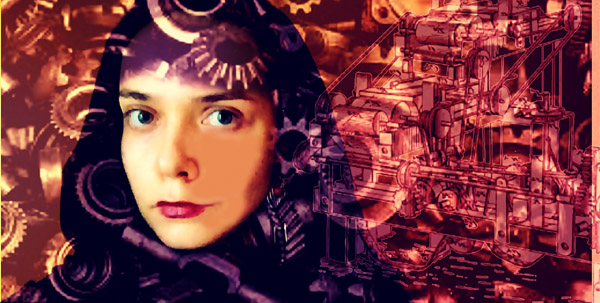
In the High Middle Ages, Hildegard of Bingen said that “The truly holy person welcomes all that is earthly.” William Blake declared in The Marriage of Heaven and Hell (1790) that “Exuberance is beauty.” In 1855, Walt Whitman published the poem “Song Of Myself, 51” in Leaves of Grass, which contains the famous line “I am large, I contain multitudes.” I’m just skimming the surface of mystical experience, of those struck by wonder and an all-encompassing insight into how people fit into the ‘grand scheme of things.’ At some point on this trajectory, the boundary between the religious and the secular breaks down and simply being human becomes the ultimate wow. Which brings us to Polish artist Maria Ka’s latest album Di Mashin. Ka found that her family had Jewish roots, a discovery that led her to an immersion in Jewish studies and the Yiddish language. As on 2023’s Der Hemshekh, she unreels original songs written in Yiddish, embracing a politically active feminism and a committed meta-universality. Her musical vision is fragrantly mystical, and she presents us with a whole Yiddish cosmos. While not sharing the same type of musical style, Ka reminds me of John Zorn’s aesthetic of mixing the grotesque and the sacred into Jewish experimental music. She also reminds me of the woman on the phone sampled on Wally Brill’s Jewish cantorial electronica album The Covenant (2007), who confesses she can’t sleep after hearing someone in a bar talking about the Book of Ezekiel and being haunted by the vision of Jews arriving from a future space-time. She sees that we are all suspended in webs of relationships. She is also deeply aware of how we are subject to larger social forces and structures – which sometimes must be met with radical action -- that are the machinery of life. There is a heavy dose of electro and punkish attitude spinning through her musical universe. Ostensibly, the album is divided between electronic and rock tracks, but there is a consistency to the sound that is united in loopy joy. At its best, Di Mashin is sly and sexy. Opening track “Alef – Tsentauri Disko” finds Ka in the city, musing on the seaside, wriggling like a snake at night, and watching Gdańsk wake up. “I often Dream about Cosmos, about the Land above the Earth / overhead / Alef Centauri Jewish disco!” she sings, set to a thumping urban electro grind. (See video below)
“Vos iz dos?” is a standout, more in the ‘rock’ vein, with Ka howling a debate over the Yiddish language itself. Perhaps it is based in a critique that she received, as she starts with What is this? Maria, what is this? Given that Ka is producing new modern songs in Yiddish, there is something disarming in acknowledging the tension over who might claim ownership of language itself.
“SuperNove” might remind listeners of Jacob wrestling with God, if that battle was done to an ‘80s new wave beat. Ka has visions of the past, the Old World and old demons, and she fights a ghost that rises to block her way: “I fought him with Strength, punched him with my both hands…I triumphed over him! I myself – I did triumph over him!” And after that victory, “it’s a great Surprise – the Past melted in the Cosmic Blast!” Ka also seems to be challenging herself, pointing in new directions. “Di Kosmish motorn (Cosmic engines)” brought to mind the former Warsaw Village Band’s blues-influenced singer Maja Kleszcz. Depeche Mode’s (fronted by Dave Gahan, of Jewish ancestry) forays into fusing electronica with blues might be another touchpoint. Hearing the cosmic engines like a modern day Pythagoras, she is awestruck by hearing the cosmic engines in her head. “Dos geverk (The mechanism)” offers some grinding guitars to convey the constant motion of the daily rat race – echoed later on by the title track, “Di Mashin (The Machine),” which peels back the layers of society to reveal the incessant obsession for money. The music of ‘The Machine’ is hyperspeed cabaret, close to madness. The system demands more money – but she indicates that she is a spanner in the works, working to bring it down: “I watch the machine’s death / Full and steadily red is my hand in the end.”
Feminist politics come to the fore on “Ikh bin a froy (I am a woman),” and Ka reminds me a bit of the divine Ms. H of Bingen chanting over a motoric beat. She refuses to be hemmed in by structures, signaling that the Forest is her home, the stars her friends; “I wake up every day / and new scroll create.” Album closer “Di milkhome” (War)” is more future blues, transposing war, empty shipyards, and advice from her mother that all miseries will end and freedom will navigate the turmoil “like huge ships at Sea.” Di Mashin is possessed by such a singular offbeat vision and personal mythology that I wonder where Maria Ka will take her Yiddishfuturism next…Perhaps beyond our solar system, grooving on an interstellar plane with her band wriggling like snakes.
Further listening:
Search RootsWorld
|