Omar Sosa
As with all Sosa’s work, Sendas is the fortunate product of serendipity. In 2021 the COVID lockdown was underway, his marriage was ending, and a scheduled Milan appearance cancellation garnered an invitation to record at the Fazioli Pianoforti Concert Hall, annex to the renowned Italian piano manufactory in Sacile, Pordenone, about an hour northeast of Venice. At Fazioli, Sosa found himself in august company. Herbie Hancock and a host of classical pianists are Fazioli artists. Among the institutions that have embraced the Fazioli sound are the Juilliard School, Teatro La Fenice (Venice), the Budapest Palace of Arts, the Paris Conservatory, the Beijing Grand Theatre, and the universities of Salzburg, Graz, and Vienna. An unscripted two-hour solo improvisation on a Fazioli grand in the empty concert hall provided the raw audio for Sendas, later to be flavored in the mix, sparsely, with voice clips, percussion, loops, field recordings, found sounds effects that Sosa has collected over a career spanning four decades. As Sosa related to me soon after completing the post-production of Sendas, “Humanity is spiritually lost. We humans are all in this together. We need to evolve, but always keeping the traditions, walking with a strong, determined pace. We need more grounded music with overtones that resonate with the lower chakras… like throat singing, a mantra of the universal music.” “Creativity is about combining all your influences in a new way. I don’t aspire to be jazz, Latin, timba, reggaeton, classical. I avoid styles, but I respect the forms.” “I try not to think about how listeners will receive it but I do try to address their expectations, and go with the music to some other new place. Many free spirits come to listen, to be a part of the journey we are on.” Sosa laughs, “My son says, ‘Your niche is really small.’ But the people who come really are there to be part of what we are going to do.” “Economics, technology, the streaming ear wash, algorithms all want to put you into a defined category — and so do many music journalists! The industry’s mentality is that any investment in artists must be defined by market categories to be profitable.” “But I play to be free of that,” Sosa says. “I play without thinking. There are no wrong notes. I love the first take. That’s the take, the natural voice of your soul. ‘Less is more’ is a mantra in my life and music.” Consider the opening of “Inside the Spirit,” easing in leisurely, reaching over the keyboard into the resonant heart of the instrument, plucking and stroking the strings, teasing out a fuller resonance — only later to be embellished in the studio mix with light percussion and the muted Spanish-language refrain of a pregonero or street vendor, as might be heard in the calles of Havana or any other Latin American barrio.
Moving from the secular to the sacred, “Deities Serenade” is an Afro-Cuban invocation of the shape-shifting divine, yet with ample room for ecumenical recasting in accord with a listener’s own self-location. “Inside My Soul” and “Something from Home” are Sosa works that to my ear may be an intuitive response to the distant call of Chopin’s "Nocturnes," to which Sosa says he listened every night for two years as a conservatory student in Cuba.
“Caribbean Movement” and “Shirma” speak to Sosa’s rootedness in the lyrical, rhythmic, and harmonic heritage of the plantation islands where African and European cultures tragically entwined. In the violent forging of the world’s first truly modern people, social, cultural, linguistic, and musical displacements proved more flexible and accommodating than many of those same people, who shaped a contentious convergence of traditions into a changing same that persists into the unfolding present, ever yet to come. With expressive transcendence such as this, seeking to reduce the spiritual essence and inspiration of Sosa’s music to words is rather a fool’s errand. Better rather to listen, to contemplate, to perceive the pathway, to wander the sonic sendas coursing to the next way station without prejudice or preconception. To that end, Scott Price, Sosa’s longtime manager and friend relates, “We are using Sendas as the springboard for our first experiments in AI-generated Omar Sosa music videos.” Absent the opportunity to see and hear Sosa perform live, the palpable ideal, these ancillary audiovisual experiments further the ineffability of his artistic quest, the unique nature of the listening experience and all that ensues.
Search RootsWorld
|

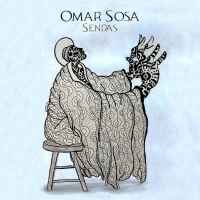 True to a Monk-inspired commitment never to play the same thing twice, Cuban pianist and composer Omar Sosa’s Sendas (Pathways), his latest solo offering, is the vivid invention of a pensive, restlessly creative, evolutionary artistry.